The Operations Blueprint.
A half-day on-site diagnostic that produces a complete picture of how your business actually operates, mapped against your operating model, prioritised by impact.
It is not a discovery call or a sales exercise. It is the first piece of work.
Businesses cannot improve what they cannot see.
Most businesses have never properly mapped how they operate. Different people understand different parts of it. Documentation exists in fragments, if it exists at all. Nobody sees the whole operational system clearly, including the founder.
That is not unusual. It is the default state of a service business that has grown faster than the operational infrastructure supporting it.
The gap between how a founder believes the business operates and how it actually operates is almost always where the most significant improvement opportunities live. The Blueprint exists to close that gap.
The Blueprint makes the invisible visible.
What the Blueprint is not.
A founder who has paid for consultancy that produced very little is already asking this question. The honest answer comes first.
- It is not a workshop.
- It is not a strategy day.
- It is not a generic consultancy discovery session.
- It is not a software audit.
- It is not a process mapping exercise conducted in isolation.
- It is not a report of recommendations with no implementation path.
- It is not a commitment to a long-term engagement.
It is a paid, scoped, bounded diagnostic. The output belongs to you. The engagement can stop after the Blueprint.
Mapped in four parts. Prioritised by impact.
The Blueprint maps your business in four parts, the four parts of the Operating Model. Each is examined with specific diagnostic questions and methods, and every observation is classified against the element it belongs to. The output describes what was found in each part, and what it means in combination.
The Business Map
A departmental and functional map of the business: every function, the specific activities each performs, and how information moves between them. A data path showing where operational information originates, where it moves to, and where it is stored. The starting point for everything that follows.
The Customer Journey
Your Value Cycle, from first enquiry through delivery to retention. Every touchpoint, the internal process behind it, the tools used, and the points where data moves cleanly or breaks. Surfaces where the journey varies depending on who runs it, and where it breaks down quietly.
Leadership & Visibility
How direction is set, decided, and communicated, together with the management information leadership can actually see. Where decisions are made on instinct because the numbers take days to assemble, and where priorities shift by proximity rather than structure.
The Four Foundations
The foundations that determine how consistently the business runs. Includes a full review of the tools the business pays for (evaluated against the mapped processes, not in isolation), and where critical knowledge lives with individuals rather than with the business.
People · Finance · Systems · Knowledge
Across all four parts, the Blueprint identifies the bottlenecks, inconsistencies, and improvement opportunities, including where automation is viable because the underlying process has been mapped. That synthesis becomes the prioritised roadmap in the output.
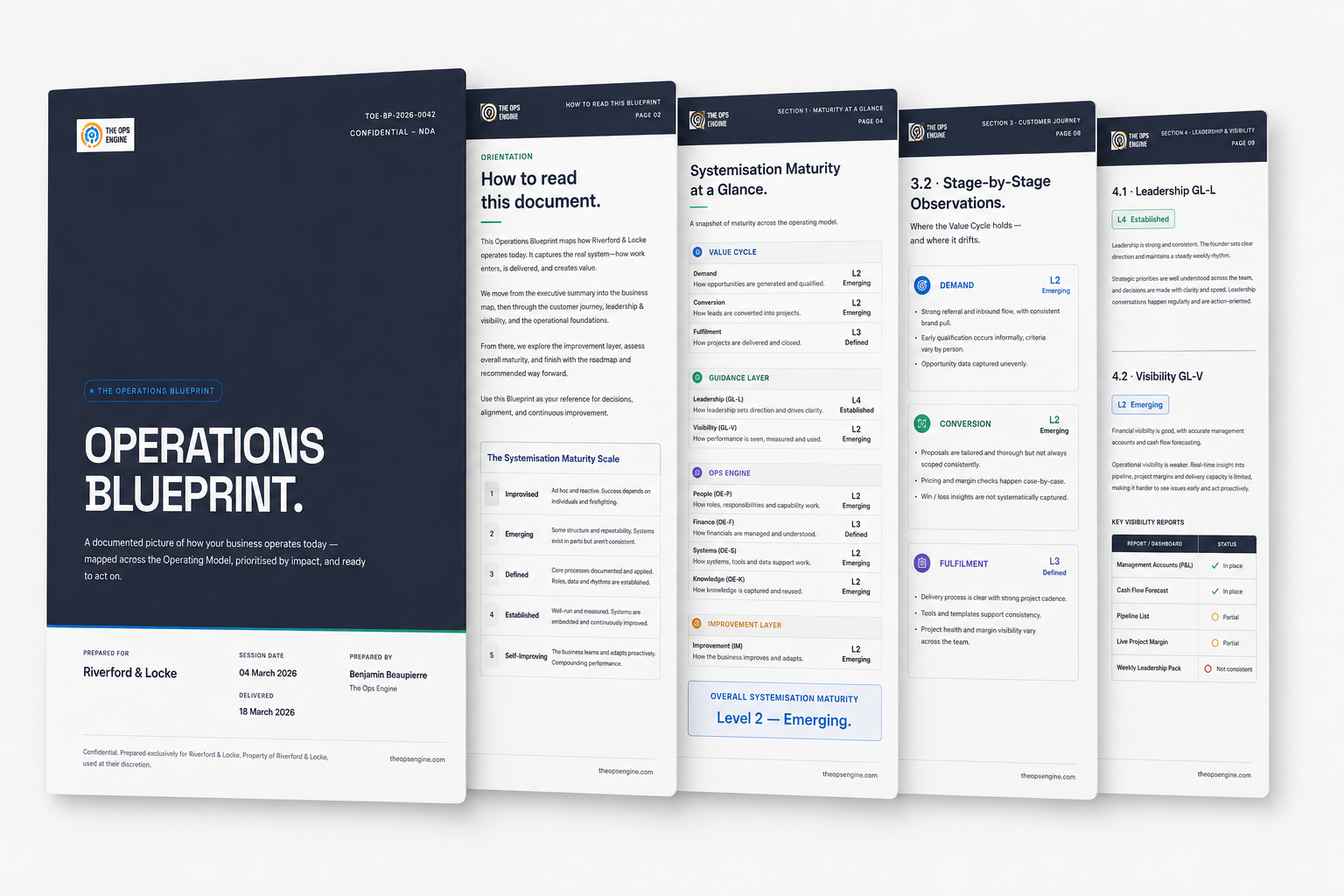
What you will receive.
The Blueprint produces a complete, structured operational picture of the business. It is the document the leadership team can use to make decisions, whether or not they choose to continue with a retainer.
- 01A complete business map across every function and the data that moves between them.
- 02Value Cycle observations, across demand, conversion, and fulfilment.
- 03Guidance Layer observations, across leadership and operational visibility.
- 04Ops Engine foundation assessment, across people, finance, systems, and knowledge.
- 05A systems and knowledge gap analysis.
- 06A prioritised summary of identified operational bottlenecks.
- 07Improvement opportunities, each with an indicative effort and impact rating.
- 08An initial recommendation on the internal systemisation candidate profile.
- 09A retainer suitability assessment, an honest view on whether further work makes sense.
- 10A recommended focus and sequencing for the retainer engagement.
The Operations Blueprint output is your property. It is a complete and usable document regardless of what follows.
What the engagement involves.
A half-day on-site session with the founder and the relevant senior team members. Conducted at your premises so the business can be observed directly, not described remotely.
On-site is essential. The informal conversations, the operational depth, the things a team member says only when standing in front of the system they are describing; these cannot be reached over video.
Followed by a compiled, structured output document presented and walked through with you. The output is not a slide deck. It is a working operational document.
Pricing is not publicly listed. It is discussed during the clarity call once mutual fit has been established.
After the Blueprint, the decision is yours.
The Blueprint is a complete piece of work in itself. The output belongs to you, and what you do with it is your decision. There are four honest options. Only one of them involves us.
If you continue: the retainer engagement.
Bi-weekly working sessions implementing the Blueprint priorities, process documentation, system design, and the development of internal capability. Structured to end, not to continue indefinitely.
The internal systemisation candidate is part of how the retainer is built, not a separate track. A team member is identified during the Blueprint and developed through the retainer to own operational development once we step away. This is the mechanism that makes the engagement genuinely bounded.
Software implementation is a conditional downstream activity, not a default. If, and only if, the retainer work shows a genuine need for a new tool, or to replace an existing one, we investigate it, recommend a choice, and can facilitate or run the implementation. The process is always mapped first. Software is never the first answer to an operational problem.
Every engagement is structured to end. The explicit goal is to make the external engagement unnecessary.
What sceptical founders usually ask.
Is this just consultancy?
No. The Blueprint is the first piece of actual work, not a discovery exercise. The output is a structured operational document that belongs to you. The engagement is designed to end with internal capability intact, not with ongoing dependency on an external consultant.
Do we need to have our systems in place already?
No. Most businesses that commission a Blueprint have fragmented or undocumented systems. That is usually the point. The Blueprint maps what exists, even when what exists is informal, partial, or held in people's heads.
Do you implement software?
Software implementation is a conditional downstream activity within the retainer, not a default, and never the starting point. If the retainer work surfaces a genuine need for a new tool, or to replace an existing one, we investigate it, recommend a choice, and can facilitate or run the implementation. The underlying process is always mapped first. Software installed before the process is mapped creates expensive confusion, not operational clarity.
What happens if we do not want to proceed after the Blueprint?
The output is yours regardless. There is no obligation to proceed to a retainer. The Blueprint is designed as a bounded, standalone engagement, not as a sales mechanism for a larger contract.
Can we stop after the Blueprint?
Yes. The Blueprint is a complete piece of work in itself. Many engagements continue into a retainer, but the structure is deliberately built so that they do not have to.
The starting point for every engagement is a clarity call.
A structured conversation about your operational situation and whether a Blueprint session makes sense. No sales pitch. No obligation. Just a clear next step.