Power. Direction. Movement. Compounding Improvement.
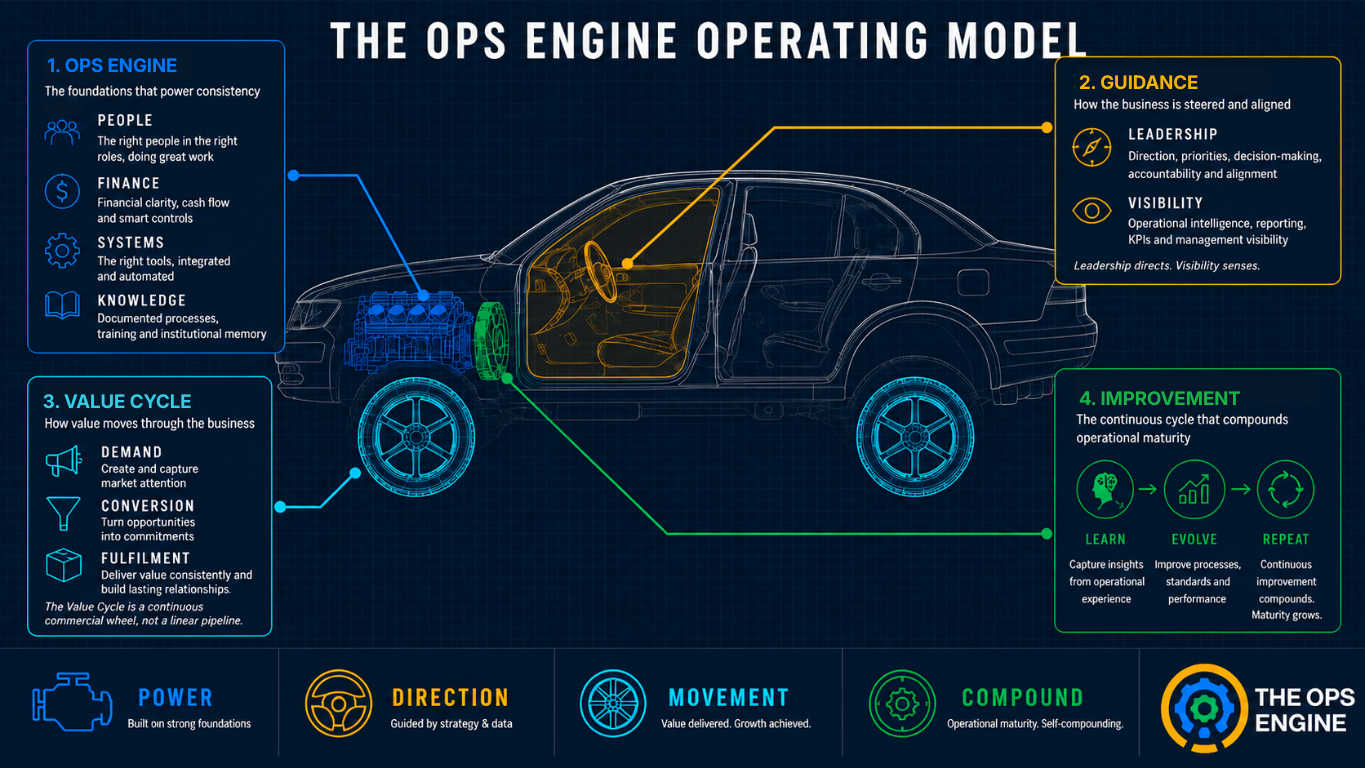
The framework used in every engagement, to diagnose, to sequence, and to communicate operational work with precision.
A mechanical model of how operational maturity compounds.
The Operating Model is the primary diagnostic, communication, and positioning framework used in every Ops Engine engagement. It captures how every service business of this stage functions, where operational friction originates, and what is required for consistent, founder-independent operation.
It has four components. Each component has a single, non-overlapping job. Every operational activity in a business has one home, and only one. That precision is what allows diagnosis to move from symptom to structural cause without ambiguity.
It is used to map the current operational state of a business, diagnose where problems originate and why, sequence improvement priorities, and classify every observation with precision.
The Ops Engine generates the power. The Guidance Layer directs it. The Improvement Layer refines it. The Value Cycle turns it into movement.
Every operational problem has a structural home. The framework names it.
The Value Cycle.
How value moves through the business commercially, from creating market attention through to retaining and developing clients. A continuous wheel, not a linear pipeline. Every business already has one. The problem is rarely its absence; it is its condition: undocumented, inconsistent, and person-dependent.
Demand
Create and capture market attention.
Marketing, brand, content, networking, referrals, outbound prospecting, partnership development.
Demand is generated informally, through the founder's relationships and unsystematised word of mouth. There is no documented approach to how the business creates and captures market attention. When the founder steps back, so does the pipeline.
Conversion
Turn opportunities into commitments.
Lead qualification, discovery, scoping, proposals, pricing, CRM, follow-up, agreement.
Conversion bottlenecks at the founder. Pricing lives in one person's head. Proposals vary in quality and format. There is no visible pipeline. Follow-up depends on whoever remembers to do it.
Fulfilment
Deliver value consistently and build lasting relationships.
Client onboarding into delivery, service delivery, project management, quality control, invoicing trigger, retention.
Delivery consistency depends on who runs the project. Client onboarding is informal and varies. Handoffs between team members produce inconsistent experiences. There is no documented standard for how work is completed.
The Guidance Layer.
How the business is steered and aligned. Two elements: Leadership directs (the decisions, strategy, and priorities that determine what the business does) and Visibility senses (the information that makes good decisions possible). Together they answer: where are we going, and what can we actually see about how we are performing.
Leadership
Direction, decisions, strategy, priorities, and accountability.
Vision and strategic direction, commercial priorities, resource allocation, decision-making structure, management cadence, leadership-level accountability, operational improvement sequencing.
The founder holds all strategic context privately. Direction is communicated informally. No structured cadence exists for reviewing performance or making decisions. Priorities shift based on proximity rather than structure. Operational improvement is reactive: whoever is most urgent gets attention.
Visibility
What the business can see about its own performance.
Key performance indicators, management reporting, dashboards, the operational intelligence required to support good leadership decisions.
Decisions are made on gut feel rather than data. Problems surface through complaints rather than early indicators. Management information requires manual assembly. The business cannot see its own pipeline, margins, or operational performance reliably, so it cannot direct itself accurately.
The Ops Engine Foundations.
The four foundational systems that generate operational capability. These foundations do not appear directly in the customer's experience, but when any foundation weakens, the effects surface immediately in the Value Cycle and the Guidance Layer's ability to function. Each has a single, tightly bounded job.
People
The right people in the right roles, doing great work.
Recruitment, role design, onboarding programme, training delivery, role clarity, team-level accountability, performance management, organisational structure.
Onboarding is informal and varies depending on who is available. Role definitions do not exist or are unclear. Performance is managed through conversation rather than structured process. Training is observational: new people learn by shadowing whoever has time.
Finance
Financial clarity, cash flow, and smart controls.
Financial management of invoicing, cash flow management, P&L visibility, financial controls, purchasing approval, management financial information.
Cash flow is reactive rather than managed. Financial position requires manual assembly to understand. Invoicing is slow because the trigger depends on one person. Margin visibility is absent or unreliable.
Systems
The right tools, integrated and automated.
Technology stack, integrations and automation, data flows and architecture, business intelligence infrastructure.
Tools have accumulated without a plan. The same data exists in multiple systems. Automation is minimal. Tools were chosen before processes were mapped, producing expensive confusion. No single source of truth for operational data.
Knowledge
Documented processes, standards, and institutional memory.
Process documentation, SOPs, playbooks, operational standards, training content, institutional memory, decision frameworks.
Processes are not documented. Training is observational. When someone leaves, their knowledge leaves. The business cannot improve systematically because it has not captured how it currently operates.
The Improvement Layer.
A continuous operational cycle, not a set of separate functions. The mechanism through which a business learns from experience and uses that learning to strengthen its Ops Engine foundations, sharpen its Guidance Layer, and improve Value Cycle performance over time. Without it, the other three components stagnate. With it, operational maturity compounds.
- 01
Learn
Review outcomes, capture insights and lessons from operational experience. Sources include delivery outcomes, client feedback, team observation, financial performance, and the data Visibility provides.
- 02
Optimise
Apply what was learned to make existing processes more consistent, efficient, and less person-dependent. The outputs update the Knowledge base: refined SOPs, improved standards, clearer processes.
- 03
Evolve
Strengthen the underlying Ops Engine foundations based on what optimisation reveals. People developed, Systems improved, Finance controls tightened, Knowledge deepened.
- 04
Repeat
Return to Learn. The cycle continues. Operational maturity does not plateau; it compounds.
Operational maturity is not built once. It is built continuously.
Symptoms appear in one place. Root causes sit somewhere else.
A founder describes what they are experiencing, usually a symptom in the Value Cycle. Delivery quality varies. Pipeline is not visible. The founder cannot step back. These are the observable conditions of the business.
Diagnosis traces the symptom to its structural origin, almost always in the Ops Engine foundations or the Guidance Layer. The Improvement Layer is the mechanism that prevents the same symptom returning.
| Symptom | Root cause |
|---|---|
| Demand depends entirely on the founder | OE-K, no documented demand process |
| Conversion bottlenecks at one person | OE-K, pricing and scoping logic undocumented |
| Proposals vary in quality | OE-K, no proposal standard |
| Pipeline not visible | GL-V, no pipeline reporting |
| Delivery quality varies between team members | OE-K, no documented delivery standard |
| Client onboarding is slow or inconsistent | OE-K, process undocumented |
| Founder cannot step back from delivery | OE-K + OE-P, knowledge not transferred, no internal candidate developed |
| Cash flow stress despite good revenue | OE-F, invoicing delayed or reactive |
| No management information | GL-V, KPIs and reporting not defined |
| Same problems recurring after fixes | GL-L + IL, improvement is reactive, not sequenced |
The framework makes diagnosis structural rather than personal. The problem is rarely the people executing the work. It is the absence of the foundations that would let them execute consistently.
The Operations Blueprint maps your business against this framework.
Every observation classified against the element it addresses. A complete, structured operational picture, prioritised by impact.
See the Operations Blueprint