Operational clarity for businesses that have outgrown improvisation
Your business should not depend on the people who remember how it works.
At a certain stage, memory, informal handoffs, and founder judgement stop scaling. The result is not a people problem. It is a structural one.
A diagnostic conversation to confirm whether the Blueprint is the right next step. No pitch. No obligation.
Knowledge captured
Critical processes no longer live only in people's heads.
Bottlenecks visible
The business can see where work slows, varies, or depends on one person.
Capability transferred
The system is built for the business to own, not for consultant dependency.
This is a common stage of business growth.
- 01
The same process gets handled differently by different team members, and there is no documented standard to point to.
- 02
When a key person is away, things slow down or fall through gaps.
- 03
New staff take far longer than they should to become effective.
- 04
You have bought tools that have not fixed the underlying problem.
- 05
Operational knowledge lives inside people's heads, not in the business.
- 06
Leadership lacks clear visibility into how the business is actually performing.
- 07
Growth is creating strain rather than confidence.

If this describes your business, you are in the right place.
Why the problem persists.
Most founders who reach this stage have already tried to fix it. They have bought software, hired consultants, attempted to delegate, and added headcount. None of it has produced lasting structural change.
There is a reason for that.

Software installed before the process was mapped
creates expensive confusion, not operational clarity.
Consultancy that produces recommendations without implementation
changes nothing structurally.
Delegation without documented process
just moves the dependency; it does not remove it.
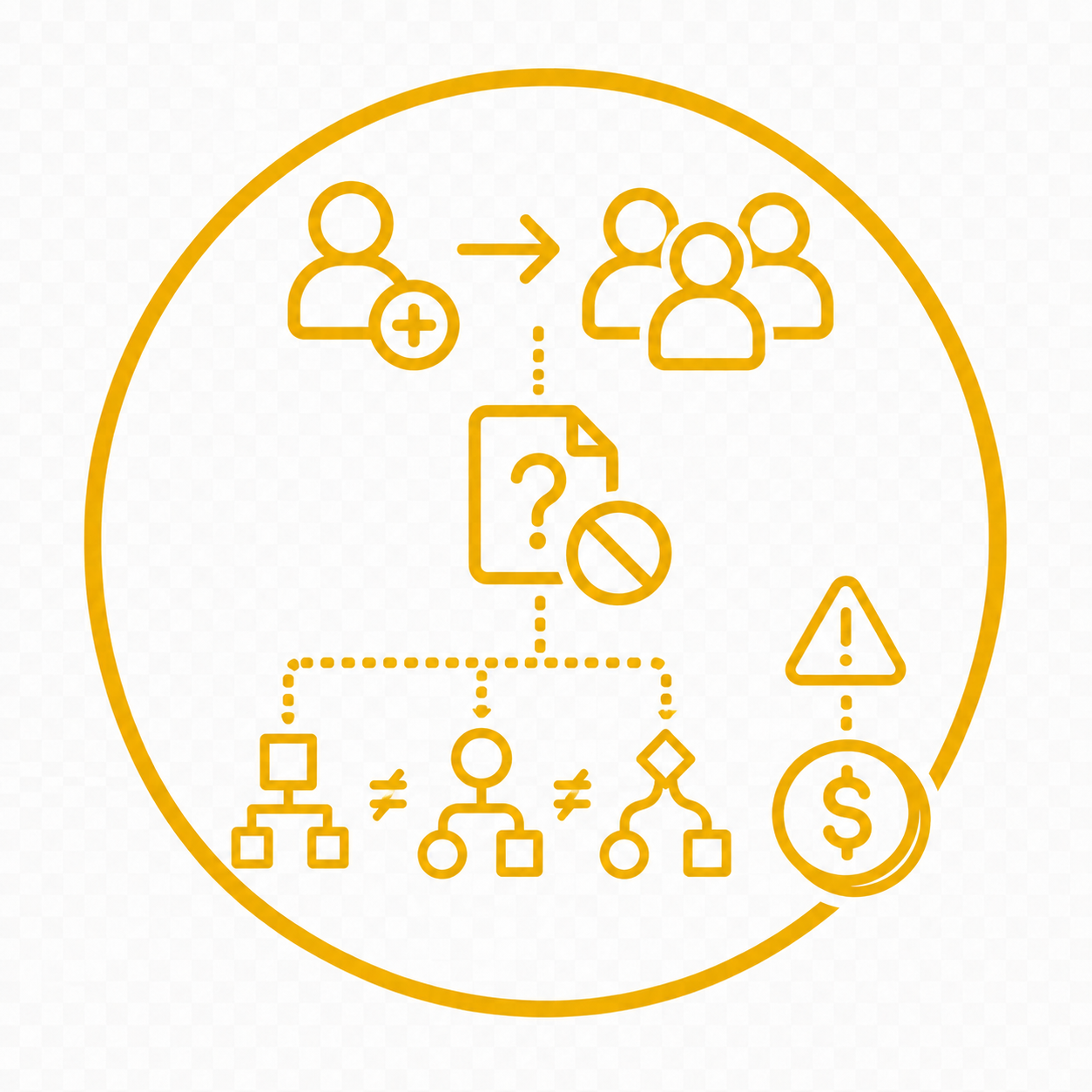
Hiring additional people into an undocumented system
replicates inconsistency at greater cost.
These are not failures of effort. They are symptoms of trying to solve a structural problem with a non-structural response.
Every operational problem has a structural home.
Operational problems rarely originate where they appear. A delivery issue is usually not a delivery problem. A client complaint is usually not a service problem. The symptom appears in one place; the cause sits somewhere else.
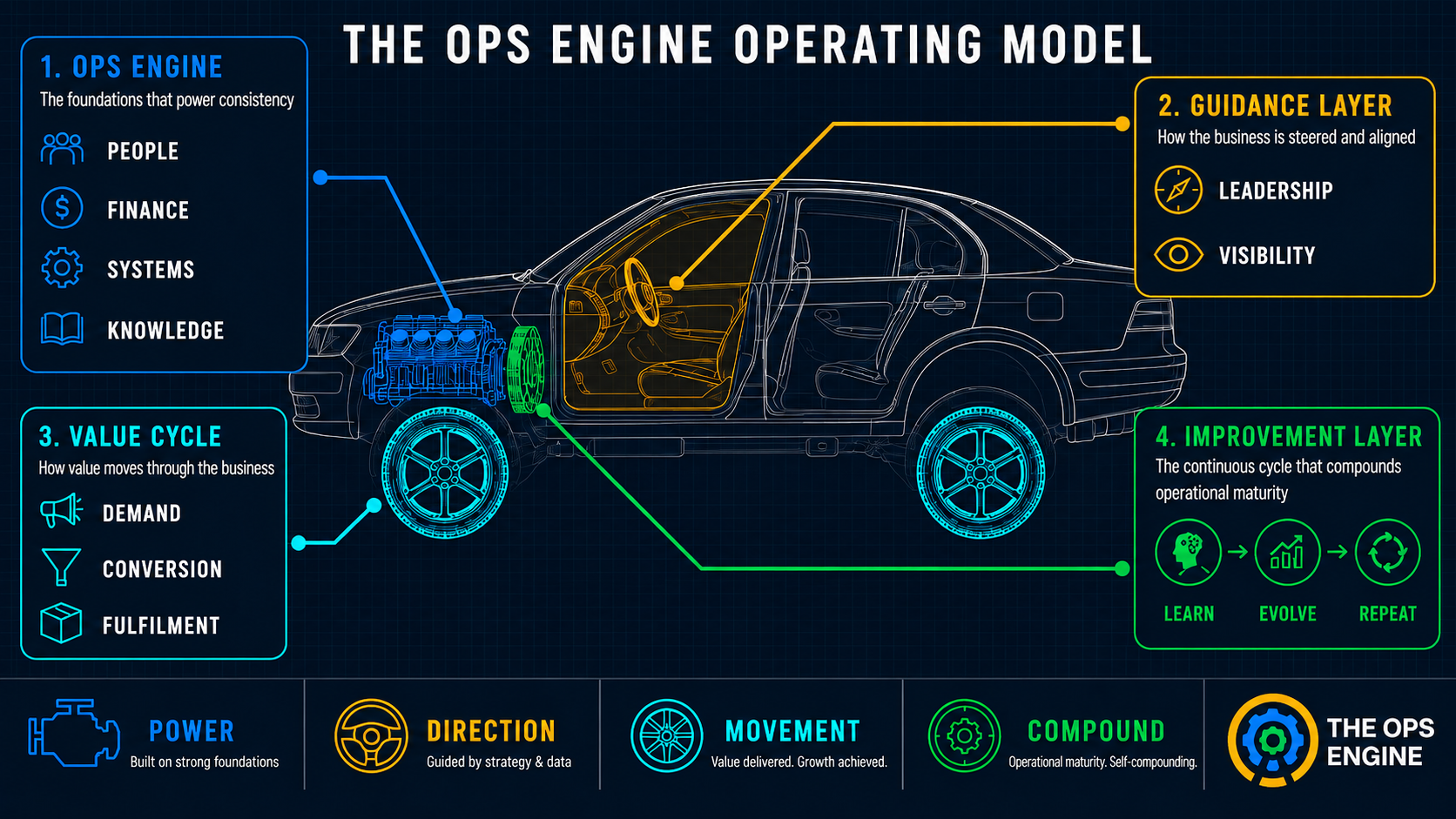
The Operating Model maps where operational problems originate, not just where they show up. Across the Value Cycle, the Guidance Layer, the four foundations of the Ops Engine, and the Improvement Layer that connects them.
The Ops Engine generates the power. The Guidance Layer directs it. The Improvement Layer refines it. The Value Cycle turns it into movement.Explore the Operating Model
The Operations Blueprint.
A paid, half-day on-site diagnostic that maps how your business actually operates, not how it is believed to operate. It maps your business in four parts, the business map, the customer journey, leadership and visibility, and the four foundations of people, finance, systems, and knowledge, then prioritises the improvements by impact.
The output is a complete, structured picture of your operational condition, prioritised by impact.
It is not a free discovery call or a sales exercise. It is the first piece of work.
The Operations Blueprint output is your property. It is a complete and usable document regardless of whether the engagement continues.See what the Operations Blueprint involves
For founder-led businesses that have outgrown improvisation.
The Ops Engine works with founder-led and owner-managed service businesses, typically 10–50 people. Established revenue. A team that has grown faster than the operational infrastructure supporting it. Common across professional services, construction and trades, IT and managed services, agencies, property, and logistics, though the framework applies wherever operational systems exist.
This engagement is not for every business. It works well in specific situations, and poorly in others. Both are described in detail on the next page.
See the full picture of who this is and isn't forEvery engagement begins with a structured diagnostic, produces a documented output, and ends with internal capability, not a continuing consultancy relationship. The specificity of the approach is the strongest evidence we can offer until the case studies are in your hands.
The Operational Maturity Diagnostic takes 10–12 minutes. It maps your operational condition across the nine areas of the Operating Model and produces a summary of where your business currently sits, useful whether or not you go further.
Take the DiagnosticIf what you have read describes your business, a clarity call is the right next step.
It is a structured conversation, not a sales pitch, about whether an engagement makes sense for your situation.